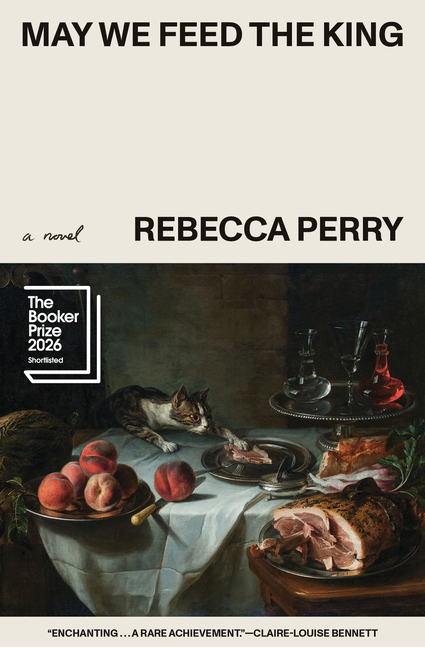
May We Feed the King
It’s likely that you’ll either be utterly intrigued or deeply put off by that summary of poet Rebecca Perry’s debut novel, May We Feed the King, a highly wrought puzzle-box of a book which deliberately wrongfoots the reader at every turn. However, the intrigued will find that it richly rewards those who approach it with curiosity – just not in the ways we as readers (and as interpreters of stories in any form) have been trained to expect ... May We Feed the King is made up of glimpses of scenes from odd angles and perspectives, with confounding reflections, shadows and movements: rooms seen through windows or from doorways, conversations half heard. It is as though we, not the long-dead courtiers, are the ghosts, as we creep around the palace peering into its rooms dressed in careful set-pieces, trying to interpret complex and momentous events from the few clues left behind ... the novel asks us to admit that we can know almost nothing about history, or even about the lives of people with whom we live contemporaneously. To read May We Feed the King is to be richly entertained but forced to sit with frustration: we want clues, we want certainty, we want a story about the King that makes sense, and Perry withholds it, instead making us watch our own minds scrabble about, compulsively putting together the scattered pieces of the past.
Read Full Review >>
As the King refuses to behave like one — i.e., to hassle, tax or slaughter anybody — Perry deftly evokes the court’s descent into confusion and paranoia in the absence of executive agency ... This is a work of historical fiction that is about fiction, and storytelling. The King’s reluctance to act — that is, to become a character — turns his reign into a narrative without plot. Robbed of any privacy, he is watched at all times, by the reader as well as by his subjects, observed through a window or a crack in a storage trunk, as though we are spying on him from within ... When we return from this medieval interlude to the present day, the curator asks the reader how we understand what we just read. 'How do we know anything about history?' she asks of an audience of 40 people who’ve come to see the palace exhibit. What is recorded of the past is only ever partial, she argues, revealing more about the teller than the subject.
Read Full Review >>
In the tradition of Julian Barnes’s Flaubert’s Parrot and A. S. Byatt’s Possession, Perry explores scholarly obsession, questioning how far it is possible for us to make contact with the past. But through her curator, this contact becomes stranger, more physical, embodied in the scenes she is staging ... In Rebecca Perry’s novel, we witness two kinds of resurrection: that found in the art of fiction and that found in the art of curation, both bringing the dead vividly back to life.
Read Full Review >>